
1. You already have a workflow. You just haven't mapped it.
Part one: map the work before you hand it over

This is the first in a series on building with agents in health communications. Before we can give an agent anything to do, we need to be clear about what we're actually handing over. That means mapping the workflow first. Everything else follows from this.
You already know what a workflow is. You just don’t call it that.
You call it “the process.” Or “how we do things here.” Or, ask Trevor”. Whatever name you’ve given it, you have one. Everyone in health communications has one. Usually several, none of which are fully documented, at least one of which runs through a single person who is the only one who understands a particular system and who is probably thinking about leaving.
A workflow, stripped of any jargon, is just this: a sequence of steps that turns an input into an output. A brief becomes a slide deck. A data package becomes a manuscript. A request from medical becomes a piece of content that has to pass through legal, regulatory, and the strong opinions of three senior stakeholders before it sees daylight.
Each step has someone responsible for it. Each step is triggered by what came before and produces something that feeds what comes next. And — here is the part that matters — most of those steps follow rules. Defined, repeatable, could-in-theory-be-written-down rules.
This is good news. We will come back to this.
Let’s make it concrete.
Take a piece of content through its typical life in health communications. Roughly, it goes like this:
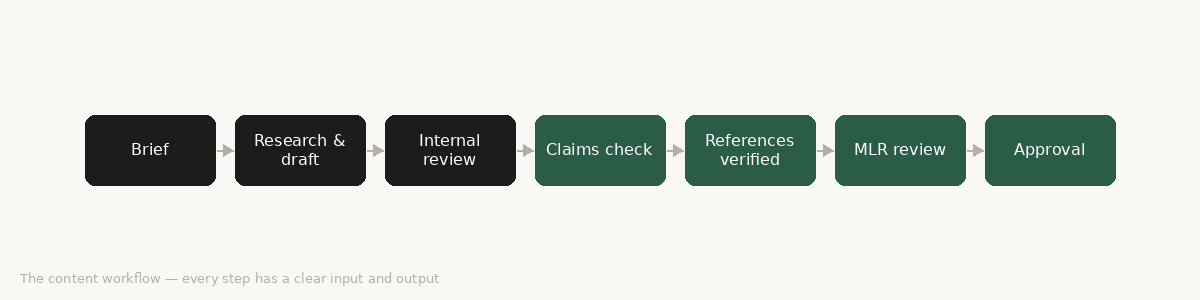
Someone writes a brief. Someone else receives it, does the background research, and writes a first draft. That draft goes to an internal reviewer — probably someone senior who has opinions about your word choices and, separately, the Oxford comma. It comes back with comments. It goes to claims checking. The claims are checked against the references. The references are verified. The whole thing goes to MLR. MLR sends it back with eighteen comments, six of which are about the Oxford comma. It goes back. Eventually it is approved. It exists in the world.
That is a workflow. A dozen or so distinct steps, each with a clear input and output, most of which follow rules that could — in principle — be written down and handed to someone who had never touched this piece of content before.
Why this matters.
Here is the insight that makes the rest of this series worth reading.
The more a step follows rules, the more it can be delegated.
This is not a new idea. It is why we have templates, and style guides, and standard operating procedures. It is why junior colleagues handle certain steps while senior people handle others. Delegation has always followed the logic of: this step is rule-governed enough that I don’t need to be the one doing it.
What’s new is who — or what — you can delegate to.
An AI agent is something that can execute rule-governed steps in a workflow without a human doing each one manually. Not all steps. Not the ones that require judgement, context, or the ability to read the room. But the ones with clear inputs, clear outputs, and clear rules? Those are exactly what agents are built for.
Before we get to any of that, though, we need to be clear about what your workflow actually looks like. Not the version in the slide deck that was last updated in 2021. The real one — with the bottlenecks, the workarounds, the step that always stalls because it depends on one person who is always in a different meeting.
Your homework. Yes, really.
Pick one workflow you touch regularly. It doesn’t have to be the big one. Something you do often enough that the steps feel almost automatic.
Write it down. Every step. Who does it, what triggers it, what comes out of it. Don’t tidy it up — write down the actual version, not the aspirational one. Especially the bits that feel embarrassing to write down.
We’ll use it next week.
Next: what an agent actually is — and how it fits into the workflow you just mapped.
— Ned