

Last week we mapped a workflow. This week we put something in it.
Last week I asked you to write down a workflow. If you did it, well done — you are in a small minority. If you didn’t, no judgement. We’ll assume you did it in your head.
Either way, you should now have a sequence of steps in mind. Something that starts with a trigger — a brief, a request, a deadline — and ends with an output. Between those two points: a series of actions, most of which follow rules, performed mostly by humans, some of whom are doing work that is considerably below their pay grade.
Now. What if some of those steps just... happened?
The thing everyone gets wrong about AI agents
Most people, when they hear “AI agent,” picture something from a film. A glowing interface. A voice saying “Processing.” Something that feels vaguely like it might become sentient if you leave it running too long.
The reality is considerably less cinematic.
An AI agent is just a system that receives a goal and works through the steps to achieve it — using tools, checking its own outputs, and stopping when it’s done (or when it genuinely needs a human to make a call it can’t). That’s it. No glowing interface required.
The key word is goal, not task. This is what separates an agent from the AI you’ve been using in generation one.
When you open ChatGPT or Claude and type a prompt, you are giving it a task: “write this,” “summarise that,” “help me with this sentence.” The AI does the task and stops. It waits for you to give it the next one. You are the system. You are doing the sequencing, the decision-making, the “what comes next.”
An agent receives a goal — “prepare the faculty briefing packs for the November advisory board” — and figures out the steps itself. It searches for the relevant publications. It pulls the speaker bios. It checks for conflicts of interest against a list you’ve provided. It drafts the packs in your template. It flags anything it couldn’t resolve. Then it stops and waits for you to review.
You stepped out of the loop for the middle bit.
Back to your workflow
Remember the diagram from last week? The dark boxes — brief, research, first draft, internal review — still have humans in them. They require judgement. They require context. They require someone who knows the client, knows the therapy area, knows what the room needs to hear.
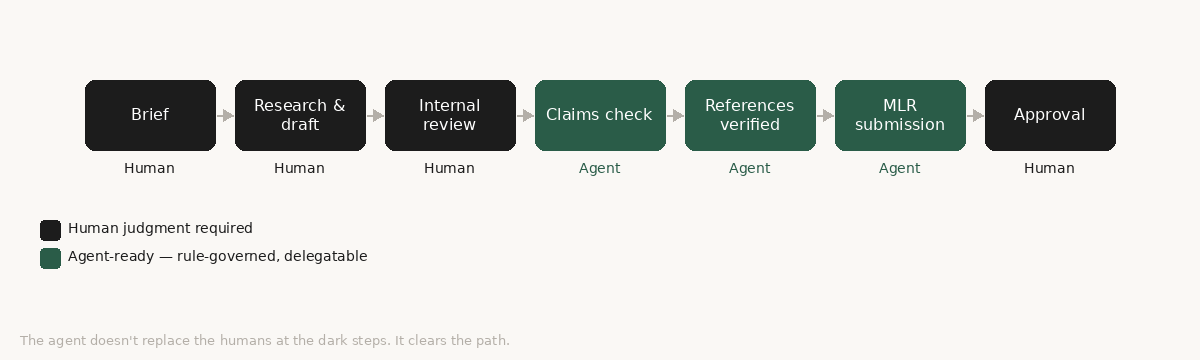
The green boxes are different. Claims checking is structured and verifiable — a claim is either accurate or it isn’t. Reference verification is binary correctness against a known source. MLR submission is document preparation with defined inputs and outputs.
These are the steps an agent can run. Not because they’re unimportant — they’re critical — but because their rules are explicit enough to be handed over.
The agent doesn’t replace the humans at the dark steps. It clears the path so those humans can spend their time on the work that actually needs them.
One thing to hold onto
An agent is not magic. It is not going to understand nuance you haven’t given it. It is not going to catch something it wasn’t told to look for. It will do exactly what you’ve designed it to do — which means the quality of the design is everything.
This is good news for people who understand the work. Building a good agent requires knowing the workflow intimately — the rules, the edge cases, the moments that require a human call. That knowledge doesn’t become less valuable when agents arrive. It becomes the thing you build with.
Next week: the actual tools. What they are, what they cost, and how to set up your first one without needing a developer.
Building with agents is a practical series on agentic AI in health communications. We start from first principles and build toward a working advisory board agent. No hype. Just the stuff that works.
— Ned