

The literature alert was the warm-up. Now we build something that actually thinks in sequence.
Last week’s agent did one thing. It searched, filtered, summarised, and sent. Most real work doesn’t look like that. It looks like a series of steps where the output of each one feeds the next — and where nothing moves forward until a human has reviewed what the previous step produced.
This week we build a multi-step workflow agent. The example is advisory board preparation.
What advisory board preparation actually involves
Advisory board preparation runs in four phases. The figure below shows them. Read it before continuing — the rest of this post is built around it.
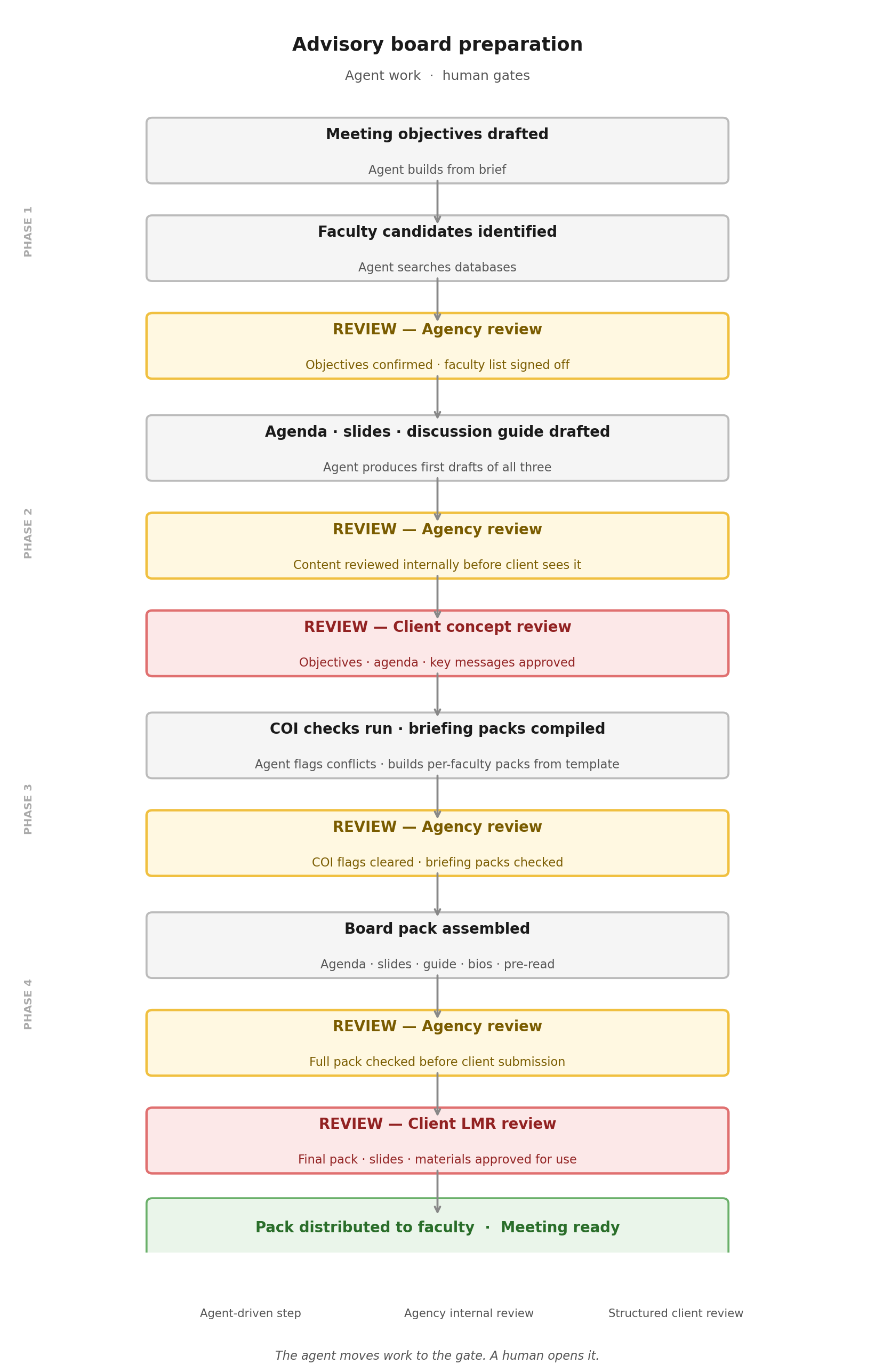
Phase one: strategic foundation. The work starts with meeting objectives — what decisions need to be made, what clinical or scientific input is required, what the board is actually for. The objectives drive everything that follows: the faculty you need, the agenda structure, the questions you ask. An agent can draft the objectives from a brief and search databases for faculty candidates. Neither output moves forward until the agency has reviewed and confirmed both.
Phase two: content development. Three documents, each dependent on the previous: the agenda, structured to deliver the objectives; the slide content, developed against the agenda; and the discussion guide, which sets out the questions, probes, and expected outputs for each session. An agent can produce first drafts of all three. They go to agency review first, then to a structured client concept review. Nothing in Phase 3 starts until that approval is in.
Phase three: faculty preparation. With approved content, faculty preparation can begin. Conflict of interest checks are run — the agent flags potential conflicts, a human reviews and clears them. Briefing packs are compiled for each faculty member: their role in the meeting, the agenda, pre-read material, background on the data they will be discussing. These go through agency review before going to the client.
Phase four: assembly and approval. The agent assembles the full board pack — agenda, slides, discussion guide, faculty bios, pre-read. It goes through a final agency check, then to LMR. Distribution happens only once LMR approval is in.
What the agent is actually doing
The agent never decides that something is ready — it produces output and presents it at a gate. A human opens the gate or sends it back.
The agent handles assembly, searching, drafting, formatting, sequencing. The humans handle judgement — is this right, does this reflect what the client actually needs, is this ready to go further.
The agent’s value is not that it replaces any of those human reviews. It is that it eliminates the time between them. Instead of a document sitting in someone’s drafts folder waiting to be started, it arrives at the review gate ready to be assessed. The bottleneck shifts from creation to decision — which is where it should be.
Before you build this: the specification question
The technology for this build is the same as last week. The hard work is not the setup. It is the specification.
Before you open the tool, you need clear answers for each phase. What does a well-formed objectives statement look like? What is the agenda template? What structure does the discussion guide follow, and who has authority to approve the questions? What counts as a conflict of interest, and who clears it? What goes into a briefing pack, and in what order?
You also need to define the gates: who reviews at each stage, what approval looks like, and what happens when something comes back with changes. An agent that does not know what a rejection looks like cannot handle one gracefully.
Get the specification right and the build is mostly plumbing. Get it wrong and you will spend more time fixing the agent than you would have spent preparing the board manually.
Next week: the full build. Step by step, tool by tool, prompt by prompt.
Building with agents is a practical series on agentic AI in health communications. New post every week.
— Ned